One Small Kitchen Tool That Will Make You a Better Baker (No, Really)
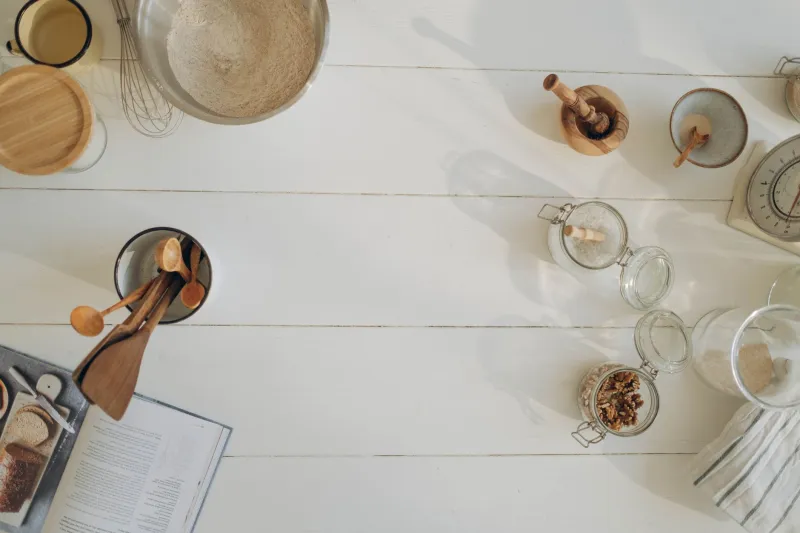
Let's talk about something that probably lives in your drawer right now, unopened or barely touched: a kitchen scale.
Maybe someone gave it to you as a gift. Maybe you picked one up and then never quite figured out how to work it into your routine. Or maybe you've been baking just fine with measuring cups for years and you're skeptical that a scale is going to change anything. That's a fair position. But stick with us here, because the case for weighing your ingredients is more practical—and more beginner-friendly—than most people realize.
The Real Problem with Measuring Cups
Here's something most recipe headnotes don't tell you: a cup of flour measured by one person can weigh anywhere from 4 ounces to nearly 6 ounces depending on how it's scooped. That's a difference of almost 50 percent. And flour is probably the most important ingredient in baking to get right.
When you scoop flour directly from the bag with your measuring cup and pack it down even slightly, you're adding significantly more than the recipe intended. That extra flour is usually why:
- Cookies come out cakey instead of chewy
- Bread dough feels stiff and doesn't rise well
- Muffins turn out dense and dry
- Cakes bake up crumbly instead of tender
None of those outcomes are your fault. They're a measurement problem. And a scale fixes every single one of them.
"But I've Been Baking This Way Forever"
This is the most common pushback, and it makes total sense. If your banana bread recipe has worked reliably for twenty years, why change anything?
Here's the honest answer: you've probably adapted without realizing it. You've learned how your oven runs hot, how your flour scoops, how your dough feels when it's right. That intuition is genuinely valuable—and it doesn't go away when you start using a scale. It just gets more accurate backup.
For recipes you've made a hundred times, a scale might not feel life-changing. But for new recipes, more technical bakes, or anything you've been struggling to get consistent? A scale removes one of the biggest variables in the equation.
How Much Does a Decent Scale Actually Cost?
This is where a lot of people are surprised. You do not need a fancy, professional-grade scale to bake better at home. A basic digital kitchen scale runs between $10 and $20 at most major retailers—Target, Amazon, Walmart—and will handle everything from weighing flour to portioning cookie dough.
Look for one that:
- Measures in both grams and ounces
- Has a tare function (this lets you zero out the scale with a bowl on it, so you can add ingredients directly)
- Has a capacity of at least 11 pounds
- Runs on standard AA or AAA batteries
That's genuinely it. You don't need Bluetooth connectivity or a backlit display or anything that costs more than $25. The $12 version does the same job.
How to Actually Use It (It's Simpler Than You Think)
If you've never baked by weight before, the process feels a little unfamiliar at first—and then it feels obvious. Here's the basic workflow:
- Place your bowl on the scale and press tare. The display reads zero.
- Add your first ingredient until the scale reads the right weight. For example, if the recipe calls for 240 grams of flour, pour or spoon flour into the bowl until you hit 240g.
- Press tare again. The scale resets to zero with the flour already in the bowl.
- Add your next ingredient. Repeat.
You end up doing most of your measuring directly into one bowl, which means fewer dishes. That alone converts a lot of skeptics.
Converting Your Favorite Cup-Based Recipes
You don't have to throw out your recipe cards. Most common baking ingredients have reliable gram equivalents that make conversion straightforward. Here's a quick reference for the ones that come up constantly:
| Ingredient | 1 Cup = |
|---|---|
| All-purpose flour | 120–125 grams |
| Whole wheat flour | 130 grams |
| Granulated sugar | 200 grams |
| Brown sugar (packed) | 220 grams |
| Powdered sugar | 120 grams |
| Unsalted butter | 227 grams |
| Cocoa powder | 85–90 grams |
| Rolled oats | 90 grams |
| Honey or maple syrup | 340 grams |
For your most-used recipes, you can write the gram measurements right on the card or save them in your phone. After a few times, you'll stop needing to look them up.
What Actually Changes When You Start Weighing
The difference shows up most clearly in a few specific places:
Cookies become more consistent. When you weigh your flour and sugar the same way every time, your cookies bake up the same way every time. No more mystery batches.
Bread and pizza dough become less stressful. These are the recipes most sensitive to flour ratios. Getting them right by weight is genuinely easier than getting them right by volume.
Scaling recipes up or down becomes simple math. Doubling a recipe when everything is in grams is just multiplication. Doubling a recipe with fractions of cups is an exercise in frustration.
You waste less. Portioning cookie dough or muffin batter by weight means every portion is actually the same size, which means everything bakes evenly.
You Don't Have to Go All In at Once
Nobody is saying you need to convert your entire recipe collection this weekend. Start with one recipe—ideally something you've made before and want to get more consistent. Make it by weight. Notice the difference. Go from there.
A lot of home bakers who resisted scales for years describe the switch the same way: it felt like a hassle until it felt like the obvious way to do things. The learning curve is genuinely short. Within two or three baking sessions, it becomes second nature.
Your measuring cups aren't going anywhere. They're still great for liquids, for rough estimates, for cooking (where precision matters a lot less). But for baking—where the chemistry actually depends on getting amounts right—a ten-dollar scale might be the most impactful thing in your kitchen.
And it fits in a drawer.